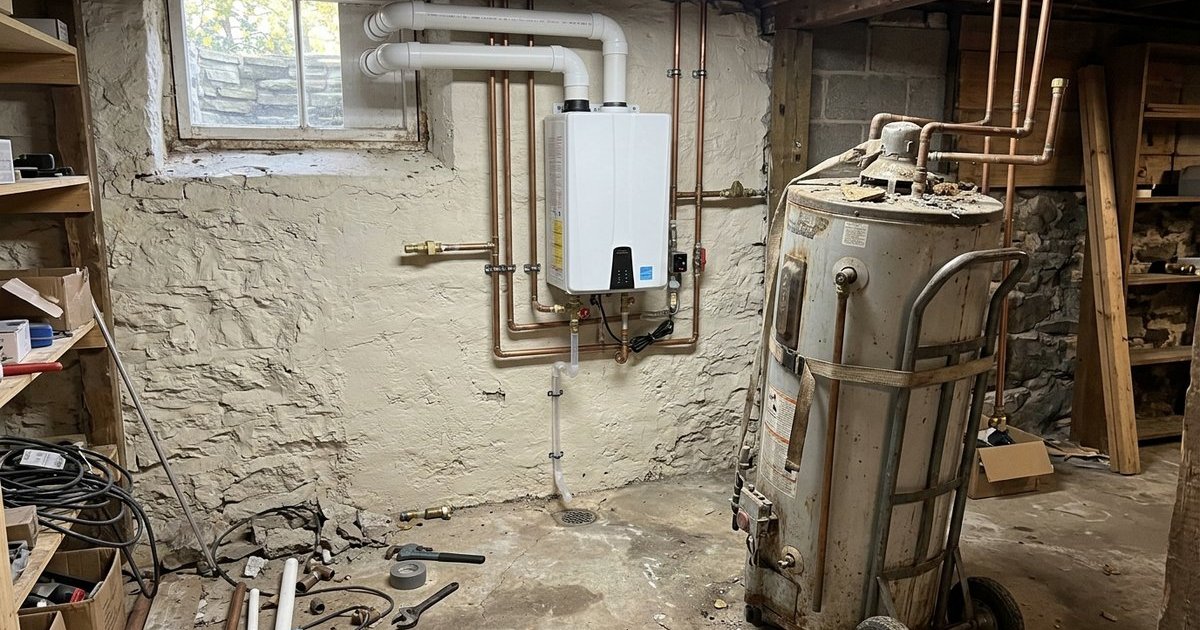
A tankless water heater fits a Chester home best when you plan to stay for years, have gas or propane with room for a bigger line, and want hot water that keeps going. A tank water heater fits best when upfront cost matters most, your gas line or panel is small, or you need a quick like-for-like swap. The rest of this guide shows how to tell which side your house falls on.
The Short Answer for Chester Homeowners
Most people asking this question are in one of two spots. Either the old tank is getting near the end of its life, or they are finishing a basement and want the floor space back. In both cases the choice comes down to five things:
- Upfront cost. A tank costs less to put in. A tankless install usually needs gas line and venting work.
- Running cost. A tankless unit only burns fuel while hot water runs, so it skips the cost of keeping 40 or 50 gallons hot all day.
- Winter flow. A tankless unit has to heat cold January groundwater on the fly, so sizing matters more than with a tank.
- Space. A tankless unit hangs on the wall. A tank needs a corner of floor.
- Lifespan and upkeep. A tankless unit can last much longer, but it needs a yearly descale, especially on well water.
None of these is a winner on its own. A family of five with back to back showers weighs them differently from a retired couple in a Deep River cape.
Upfront Cost: Why Tankless Costs More to Install
The unit is only part of the price. What usually makes a tankless install cost more is the work around it.
Gas line size
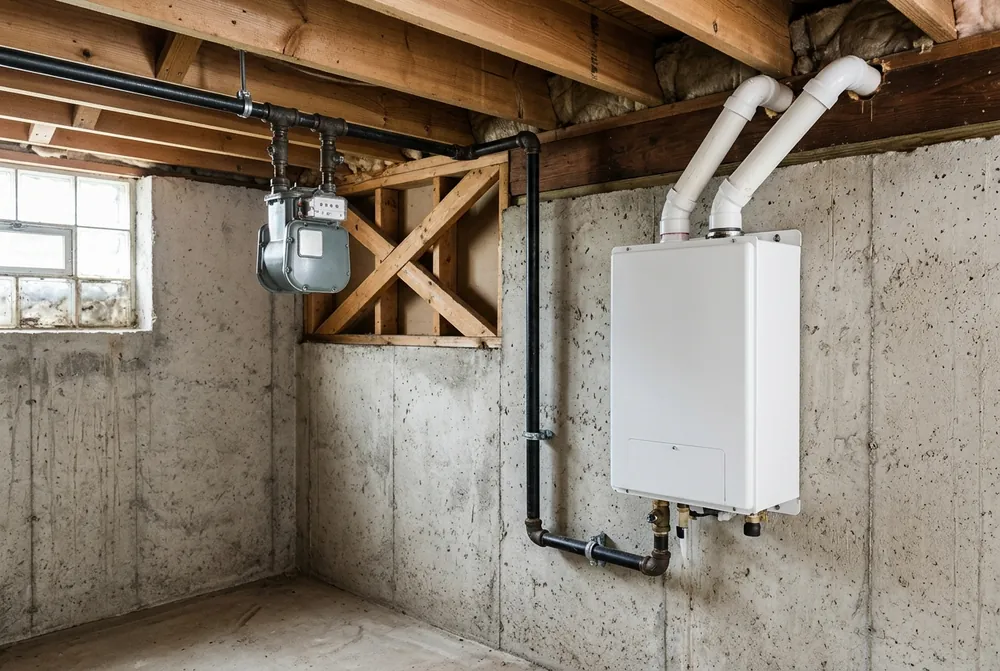
A tankless heater burns a lot of gas for a short time while a tap is open. The line that fed your old tank is often too small for that. Many homes need a larger line from the meter, and some need the gas utility to upgrade the meter itself. A tank swap almost never needs this.
Venting
A gas tank usually vents into a chimney. Most tankless units vent through their own pipe out a side wall or the roof. That means a new vent route, and if the old chimney still serves a boiler or furnace, a check that the remaining appliance still drafts safely once the water heater comes off it.
Condensate drain
High-efficiency condensing tankless units make a little acidic water while they run. That needs a drain line, and sometimes a neutralizer, to a floor drain or pump.
What this means for your budget
If you already have a tankless unit and are replacing it, the gas line and vent are often reusable, and the job gets much simpler. If you are going from a tank to tankless for the first time, plan for the full set of work. Our tank-to-tankless conversion page explains each step of that switch.
We do not post a flat price, because the gas line and vent route change the job from house to house. Your estimate covers all of it, and most estimates are free over the phone from photos.
Running Cost and Lifespan
This is where tankless earns its higher price, if it is going to.
A tank keeps its water hot around the clock, even overnight and while you are away. That standby heat loss is fuel you pay for and never use. A tankless unit skips it. According to ENERGY STAR, a certified gas tankless water heater can save a family of four about $95 a year on gas bills compared with a standard gas storage model, and tankless units have a life expectancy of about 20 years.
A typical tank lasts 8 to 12 years. On the hard, iron-rich well water common around Chester, Haddam and Deep River, tanks often land at the short end of that range. So over 20 years, a home with a tank may buy two tanks while a home with tankless buys one unit.
The catch: that long life assumes yearly care. Scale from well water builds up inside a tankless heat exchanger the same way sediment builds up in a tank. A descale once a year, made easy by service valves fitted at install, is what gets a tankless unit to its full life. Our water heater maintenance service covers it.
Hot Water Supply: Endless, Within Limits
A tank gives you a set amount of hot water, then slows down while it reheats. A tankless unit keeps heating as long as water flows, but only up to its flow rate.
Why January matters in Connecticut
Groundwater here gets cold in winter. A tankless unit has to raise that water much further in January than in August, and the colder the incoming water, the lower the flow it can deliver at shower temperature. A unit sized from a summer guess can give lukewarm showers in February when two bathrooms run at once.
That is why sizing is the step that decides whether tankless works in your house. We count your fixtures, ask which ones run at the same time, and size for winter water, not an average day.
When a tank still makes sense for supply
- Your household uses hot water in short bursts and rarely runs two showers at once.
- You fill a big soaking tub and the tankless unit you would need is larger than your gas line can feed.
- You are on electric with a small panel. Whole-house electric tankless units draw a lot of power, and many panels cannot supply them.
Space, Fuel and Your House
Space
Most tankless units are about the size of a carry-on suitcase and hang on the wall. That frees the floor where a tank stood, which helps in a finished basement, a utility closet or a small Essex or Old Saybrook cottage where every square foot counts.
Natural gas, propane or electric
Natural gas service is limited in many River Valley and Shoreline towns, so many homes run on propane. Propane tankless units are common and work well, but the propane tank, regulator and line all have to keep up with the unit while it runs. We check those before recommending a propane tankless setup.
Electric homes have fewer good tankless options because of the panel load. For many of them, a new electric tank, or a switch to propane tankless with new piping and venting, are the realistic choices.
Well water
If your home is on a private well, plan for water quality either way. Hard or iron-rich water shortens tank life and scales tankless heat exchangers. A softener or filter at the well protects both, and it is worth testing your water before you choose.
Rebates and Incentives
Energy-efficiency programs change each program year, so check what is current before you buy. Guild Water Heater Experts is a registered Energize CT contractor and can help you look at the rebates and incentives that apply to your home. Start with Energize CT to see current programs.
A Quick Way to Decide
Answer these five questions:
- How long will you stay in the house? Five years or more favors tankless, because the running savings and longer life need time to pay back.
- How old is your current tank? If it is 8 years or older, a planned switch now beats an emergency swap later.
- What fuel do you have? Gas or propane with room for a bigger line favors tankless. A small electric panel favors a tank.
- How do you use hot water? Several showers at once or a large tub means a carefully sized tankless unit, or a larger tank.
- Will you keep up with a yearly descale? If not, a tank is the more forgiving choice.
If most of your answers point to tankless, read more about our tankless water heater installation service. If they point to a tank, our water heater replacement page covers sizing and what a complete replacement includes. Not sure your tank is due? Our post on signs you need water heater replacement in Chester can help.
What Happens at the Estimate
A licensed technician checks your current water heater, the gas meter and line size or electric panel, where a vent could exit, and where a tankless unit would hang. We ask how your household uses hot water. You get the options for your house in writing, tank and tankless where both fit, so you can compare them side by side.
Want a rough idea first? Text us a few photos of your water heater and its label and we will call you back with a free phone estimate.
Talk to a Licensed Water Heater Pro in Chester
Guild Water Heater Experts is an owner-operated, licensed and insured company based in Chester and run by Erik Anderson Sr. Our Connecticut heating license covers the gas line and venting, and our plumbing license covers the water side, so one company handles the whole job across the CT Shoreline and River Valley. See tankless water heater installation in Chester for local details.
Call (860) 510-6899, book online or contact us to get your free phone estimate.