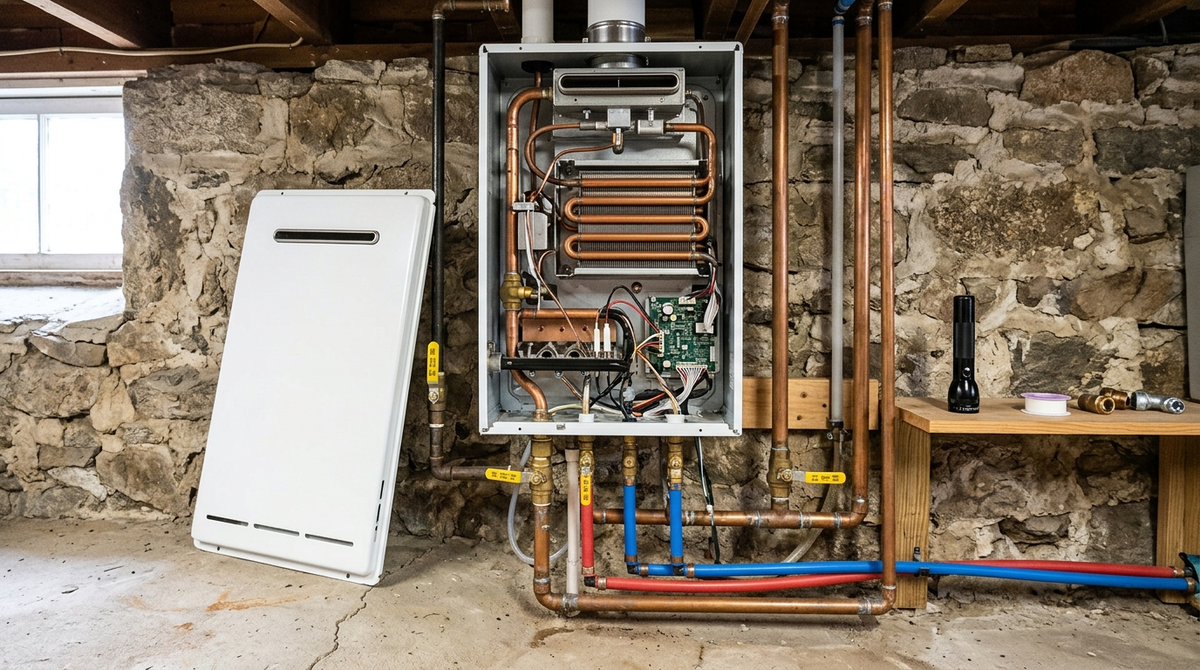
If a seasonal home on the Connecticut shoreline will sit unheated over winter, the water heater should be shut off and drained before you close the house. Water left in a tank or a tankless unit can freeze, crack it and flood the space when the house warms up, and none of that shows until you come back in spring.
This guide covers when draining is needed, what a fall shutdown involves for tank and tankless units, and how to bring the heater back safely when you open the house.
When a Water Heater Needs to Be Drained
The deciding question is whether the space around the water heater can drop below freezing.
- House left unheated: drain it. This is the usual case for summer cottages in Old Saybrook, Westbrook, Clinton and Old Lyme that are closed after the season.
- Heat left on low: many owners keep the heat at a low setting all winter. The water heater can stay in service, but a power or fuel outage in a January storm can still leave pipes and the heater exposed. If nobody checks the house, draining is the safer choice.
- Heater in a crawlspace, garage or unheated porch: these spots freeze long before the living space does, even with the heat on.
Manufacturers agree on the basic rule. A.O. Smith's installation manual, for example, says the water heater should be drained if being shut down during freezing temperatures, and that the drain valve should be left open if it will be shut down for an extended period. Your own model's manual governs the details, so keep it with the unit.
What Freezing Does to a Water Heater
Water expands when it freezes. In a tank, that can split fittings, crack the drain valve or damage the relief valve. In a tankless unit, the narrow heat exchanger tubes and the water connections are the weak points, and freeze damage to the heat exchanger is often the most expensive repair a tankless unit can have.
The damage is also easy to miss. A cracked fitting does not leak while it is frozen. It leaks when the house is warmed up and the water is turned back on, which is why a careful spring start-up matters as much as the fall shutdown.
What a Fall Shutdown Visit Covers
Tank water heaters
- Turn off the fuel or power. Gas or propane control to off, or the breaker off for an electric tank. An electric tank must never be powered while empty, because the elements burn out in seconds.
- Shut off the cold water supply at the valve above the tank.
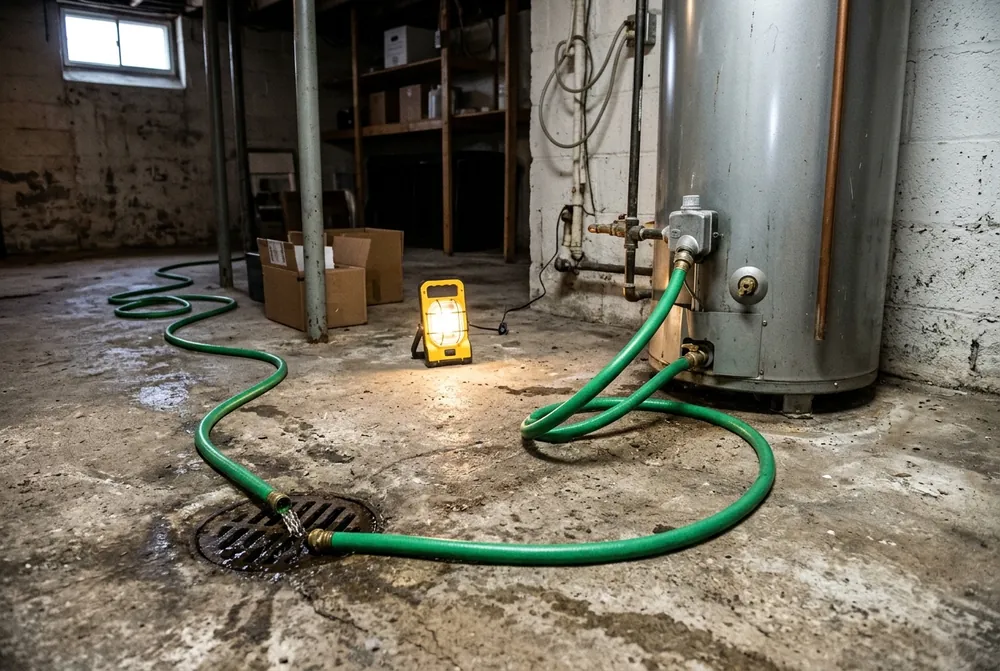
- Drain the tank through a hose to a floor drain or outside, with a hot water tap open upstairs to let air in.
- Leave the drain valve open, as the manufacturer instructions call for in an extended shutdown.
- Drain the house lines so the piping to and from the heater is empty too.
- Inspect while it is empty. A drained tank is the right moment to look at the drain valve, the relief valve and the anode rod. Rust at the fittings or a worn anode is worth knowing about before spring.
Tankless water heaters
- Turn off the gas and the power to the unit.
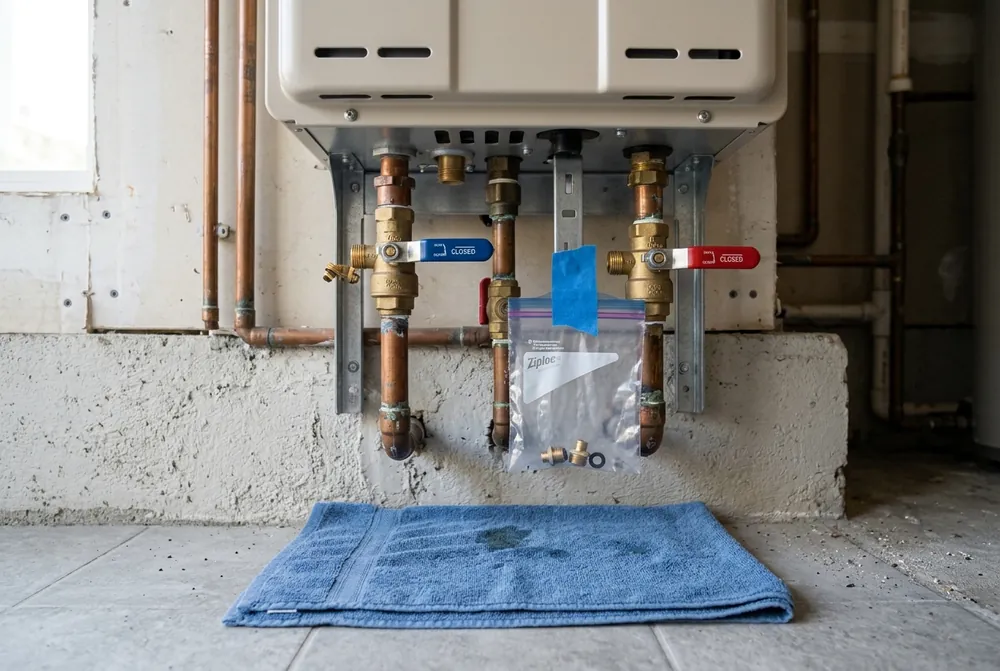
- Close the service valves on the hot and cold lines.
- Open the drain plugs on the unit and let it empty fully, including the inlet filter housing.
- Drain the condensate trap on condensing models, since it holds water too.
- Leave the drain plugs out, bagged and taped to the unit so they are easy to find in spring.
A unit with built-in freeze protection still needs power and gas to protect itself. In an empty house, a storm outage takes that protection away, so draining is still the safer plan.
Things Owners Often Miss
- The expansion tank and recirculation pump hold water as well. They need draining with the rest of the system.
- Boiler-fed indirect tanks. If your hot water comes from the boiler, the heating system has to be part of the plan. Tell us about this when you call.
- Well pumps. On a private well, the pressure tank and pump need attention too, or the system can refill the lines you just drained.
- A note for spring. Leave a clear label on the water heater saying it is drained and the fuel is off, so whoever opens the house knows to refill it before turning it on.
Starting the Water Heater Back Up in Spring
The order matters, especially on electric tanks.
- Close the drain valve or put the drain plugs back.
- Open a hot water tap in the house.
- Turn the cold water supply back on and let the tank or unit fill until water runs steadily from the open tap, with no sputtering air.
- Check for leaks at every fitting, the relief valve and the drain valve before turning on the heat.
- Turn the fuel or power back on, and relight a gas pilot following the label on the unit.
- Watch it for the first hour. A slow drip at a fitting is much easier to catch now than after it has run for a week.
If anything leaks, or a gas unit will not light, turn it off and call. Our water heater repair service handles anything the winter left behind.
Why Have a Pro Do It
You can drain a water heater yourself, and many owners do. A licensed visit makes sense when the heater is gas or propane, when the drain valve is old plastic that may not close again, when the house has a boiler-fed indirect tank or a well system, or when you will not be back to check the house yourself.
On a fall visit we can also flush the sediment out of the tank or descale a tankless unit while it is already off, which covers the yearly maintenance in the same trip. Most tank flush and inspection visits take about 1 to 2 hours.
Book a Fall Shutdown With Guild Water Heater Experts
Guild Water Heater Experts is an owner-operated, licensed and insured company based in Chester, serving the CT Shoreline and River Valley from Old Saybrook and Westbrook to Clinton, Madison and Old Lyme. Read more about our water heater maintenance service, or see water heater maintenance in Old Saybrook for local details. Our post on preventing sediment build-up covers the yearly care for homes you live in year round.
We are open Monday to Friday, 8 AM to 4 PM. Call (860) 510-6899, book online or text us photos of your water heater for a free phone estimate.